
Genetic Alliance UK works in collaboration with and on behalf of its members across the UK to support high level change to improve the lives of people living with genetic, rare and undiagnosed conditions.
2026
New Report: Independent Evaluation of the Generation Study: Views of support organisations
We’re pleased to share Genetic Alliance UK’s new research report, Independent Evaluation of the Generation Study: Views of support organisations.
The Generation Study aims to sequence the genomes of 100,000 babies to test for over 200 conditions – and to inform future policy around newborn screening. The Generation Study is ongoing and is being independently evaluated by a team of academics and our own researchers at Genetic Alliance UK.
Our report draws on this research and presents the experiences of rare condition support organisations. It explores how these organisations have engaged with the Generation Study to date, how prepared they feel to support families, and what is required to enable them to fulfil their role effectively.
Full findings from the evaluation – including the views of parents and healthcare professionals, health economics and the clinical impact – will be published once the Generation Study is complete.
Please email [email protected] if you have any questions.
Equity for rare policy report
Equity for rare: Delivering fairer healthcare systems for people with rare conditions is Genetic Alliance UK’s Rare Disease Day policy report. It presents findings from our community consultation into what healthcare equity means for people living with rare conditions.
We found that people with rare conditions experience profound healthcare inequity because healthcare systems are simply not designed with them in mind. The experiences and views shared were illustrated by Rose Matheson (illustrator and paramedic, Scotland).
The report explains that healthcare systems often treat rare conditions as a low priority. Equitable care is further limited by a lack of evidence and low levels of clinical familiarity. These systemic challenges frequently intersect with ethnicity, gender, and socioeconomic status, deepening existing inequities in healthcare.
To deliver a fairer healthcare system, we call on the UK governments to:
- Deliver a UK-wide map of all 7,000 rare conditions via funded rare conditions registries.
- Close the evidence gap through fair and balanced research investment.
- Mandate system-wide accountability to stress-test policies against rare conditions.
- Embed rare conditions into mainstream healthcare delivery
- Commit to a bold successor to the UK Rare Diseases Framework.
Involvement by design: How to address structural and cultural barriers to PPIE in academic research
We’re pleased to share our new report Involvement by design: How to address structural and cultural barriers to PPIE in academic research. The report sets out how patient and public involvement and engagement (PPIE) can be more meaningfully embedded across the research system. While it is grounded in the experiences of rare condition researchers, its findings are relevant across a number of biomedical and healthcare research disciplines.
Meaningful PPIE is widely recognised as essential to high-quality research. However, many researchers continue to face structural and cultural barriers that make it difficult to deliver in practice. By bringing together researchers at different stages of their career to explore these issues in more depth, we have developed a set of recommendations to address these challenges and help drive systems-level change in academic research.
The eight recommendations we have set out focus on what needs to change. They aim to address the core structures, resources and incentives needed to embed meaningful PPIE and are intended for both institutions and individuals across the research ecosystem.
- Take a shared approach to responsibility for delivering PPIE
- Commit adequate project funding dedicated to delivering PPIE
- Professionalise and expand PPIE training for researchers
- Develop organisational strategies to maximise diversity and inclusion
- Simplify institutional reimbursement processes for PPIE
- Build cultures of peer sharing and learning-by-doing
- Integrate PPIE into career progression and appraisal frameworks
- Enhance the visibility of PPIE in research outputs
Crucially, the recommendations are not a call to stretch existing resources further or to place responsibility solely on researchers. Alongside the need for leadership from those with influence in academia, funding and publishing, the report also identifies practical ‘quick wins’ that can help embed meaningful change now.
‘What struck me when reading the report is the importance of shared responsibility and collaboration in order to address the barriers. We need to see a range of different organisations stepping up to take the lead on the different recommendations and actions.’
Dr Natasha Ratcliffe, Principal, Patient Engagement, LifeArc
‘If embraced, the recommendations in our new report have the potential to improve the quality, relevance and impact of research, particularly research into rare conditions, where the level of unmet need remains high.’
Amy Hunter, Director of Research, Genetic Alliance UK
We hope the report is a useful contribution to ongoing discussions about strengthening research culture. For any questions, please email: [email protected]
Involvement by design: How to address structural and cultural barriers to PPIE in academic research
2025
Time to Decide: Learning from international approaches to newborn screening decision-making
We’re pleased to share Genetic Alliance UK’s new policy report, Time to Decide: Learning from international approaches to newborn screening decision-making.
Expanding population screening for genetic and rare conditions is a key part of our five-year strategy. While many countries now screen for over 20 conditions, only nine conditions are included in the UK’s NHS Newborn Blood Spot Screening Programme. There is growing consensus from across the rare community and Genetic Alliance UK’s broader network of stakeholders that this needs to change.
The report explores how the UK National Screening Committee (UK NSC) can accelerate its approach to decision-making for expanding newborn screening, drawing on research findings from 14 countries to identify practical, evidence-informed steps for improving the way decisions are made in the UK. It also considers the role of genomic newborn screening.
The report calls on governments and health system leaders to:
- adopt a pragmatic approach to evaluating evidence for genetic and rare conditions
- strengthen the involvement of patient organisations in decision-making
- ensure greater transparency in decision-making
- introduce more agile review processes to prevent unnecessary delays and promote readiness for new screening technologies
- commit to a long-term plan for broader health systems innovation, including readiness for new therapies.
We hope the report is a useful contribution to current discussions. We will be building on the report’s findings and messaging through a public affairs campaign to align with events related to newborn screening across the year. For any questions, please feel welcome to email [email protected]

Time to Decide: Learning from international approaches to newborn screening decision-making
More than you can imagine: opportunities for improving the lives of people with rare conditions
Genetic Alliance UK’s Rare Disease Day policy report ‘More than you can imagine: opportunities for improving the lives of people with rare conditions’ reflects on the impact of the UK Rare Disease Framework and highlights the significant unmet need that continues to exist in the rare condition community.
The report recognises that the existing Framework has laid strong foundations and since its publication, new opportunities have emerged.
There is strong support for renewing the Framework among the rare conditions community. The report calls on the governments of the UK to renew their commitment to rare conditions and ensure that the successor to the existing UK Framework is supported by:
- Ring-fenced funding for each nation
- Well-resourced delivery teams for effective implementation
- Ongoing involvement of the rare conditions community
- Enhanced collaboration across the four nations, including joint initiatives
- Development of clear metrics to monitor progress and evaluate outcomes
- Regular reporting of progress to facilitate comparison and collaboration
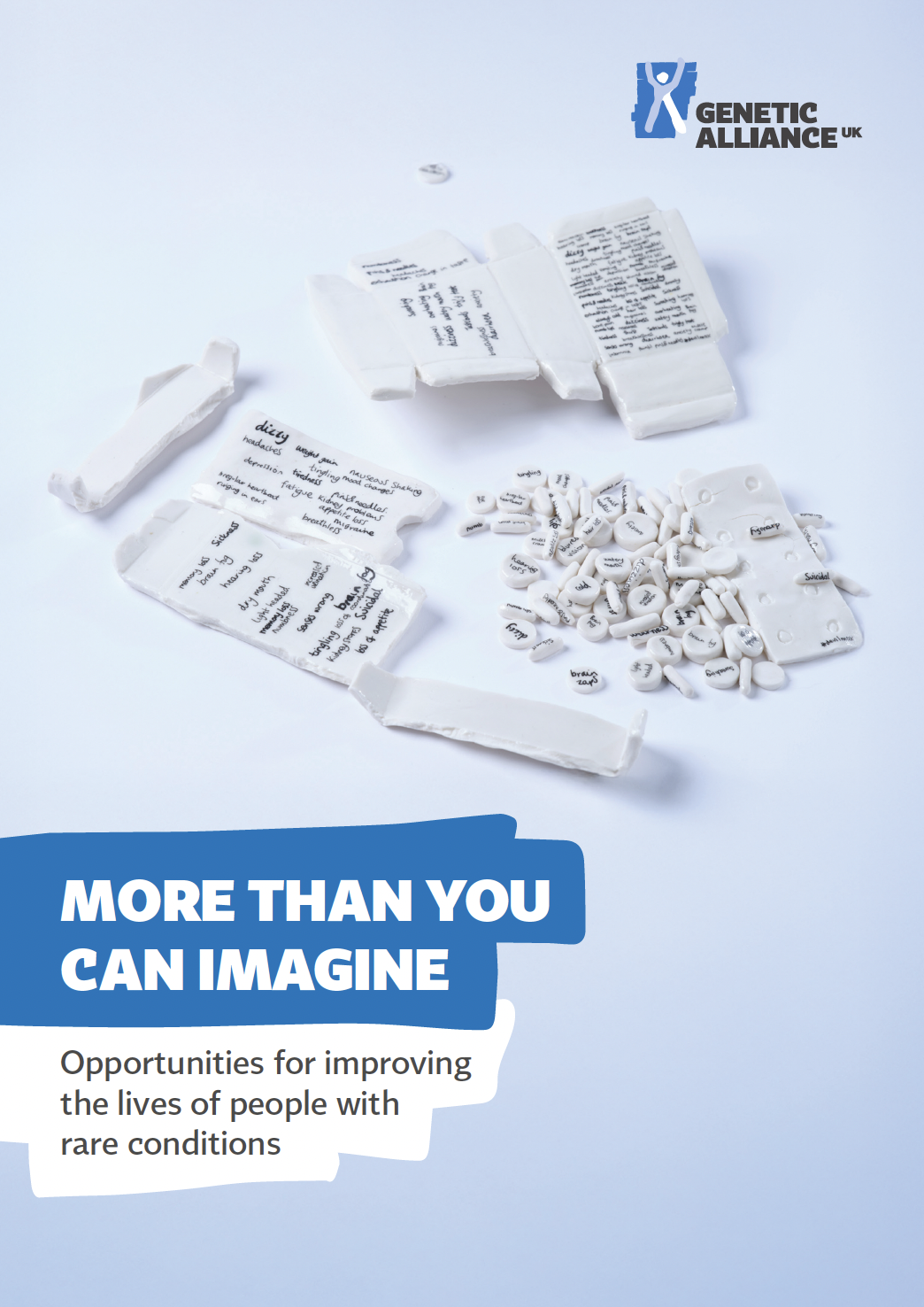
More than you can imagine report
More than you can imagine: an anthology of rare experiences
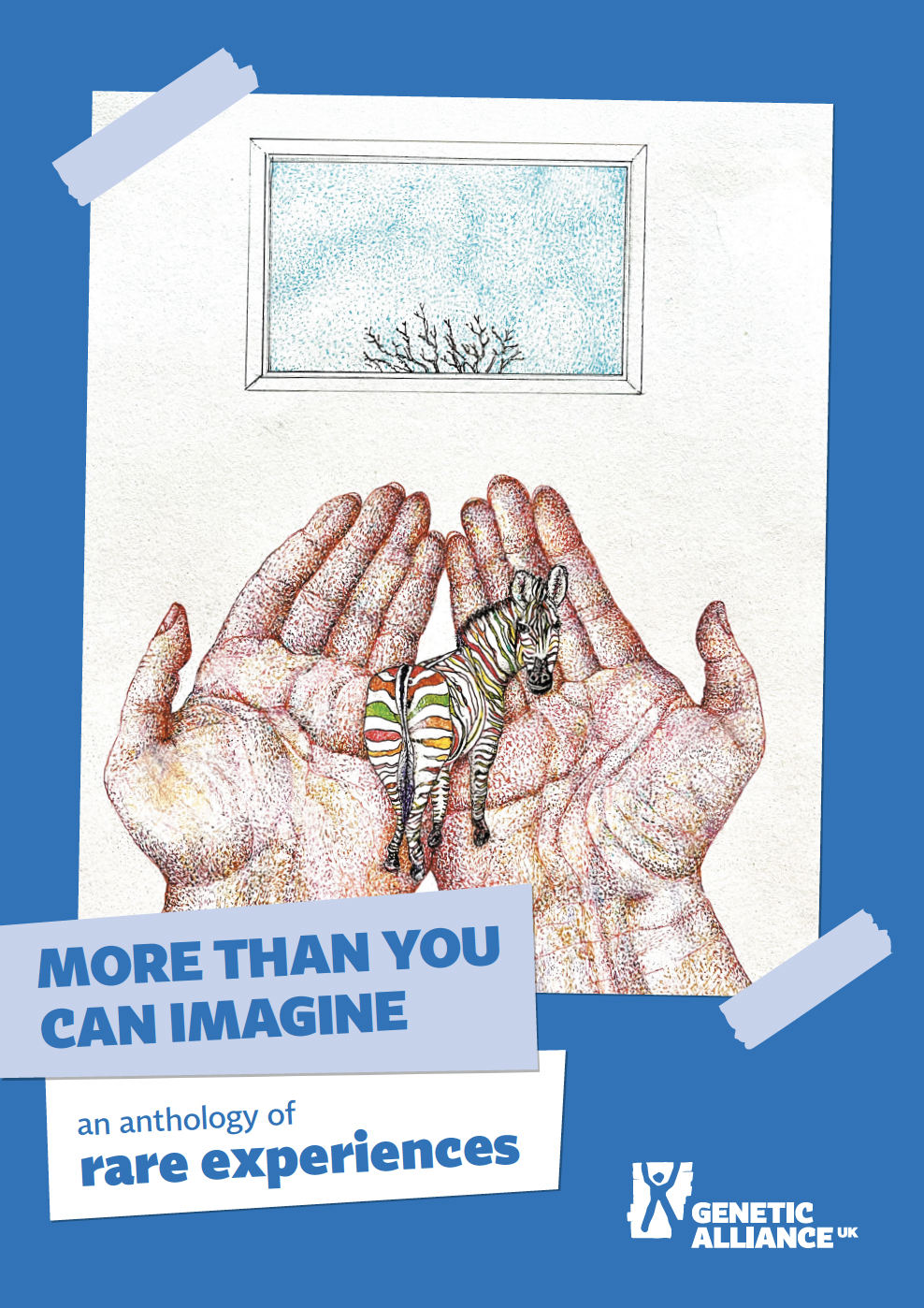
To mark Rare Disease Day 2025, Genetic Alliance UK produced ‘More than you can imagine: an anthology of rare experiences’. The anthology is a powerful collection of creative works that bring to life the experiences of individuals within the genetic, rare, and undiagnosed communities through poetry, personal stories, photography, and artwork.
Featuring over 60 submissions, the anthology has themes of resilience, isolation, mental health, and the experience of ‘fighting’ for care echo throughout. But so too does the strength found in support and community.
While each story is deeply personal, it is impossible to ignore the shared challenges. Delayed diagnoses, a lack of awareness among healthcare professionals, fragmented care, and barriers to accessing treatment and support.