
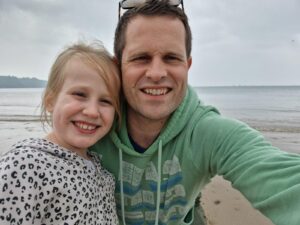
Remembering rare conditions – Huw’s story
After a phone call revealed his baby daughter had cystic fibrosis, Huw reflects on the shock, hope, and the urgent need for fairness in rare disease care.
A life-changing phone call
The phrase ‘flashbulb memory’ is used by psychologists to describe the exceptionally vivid and enduring memories we form when we learn about shocking events. Some such events are public, leading to the creation of memories en masse; hence, many of us can remember with surprising clarity where we were when we learnt about the death of Princess Diana or the 9/11 attacks. Other events are more personal and generate memories that have few, if any, counterparts in the recollections of others. A personal flashbulb memory of my own relates to a phone call I took towards the end of my afternoon clinic working as a recently qualified general practitioner in October 2015. Having concluded my final consultation of the day I was gathering up my paperwork when my phone rang, displaying my wife’s number. I recall coming to an abrupt stop adjacent to the office printer when she told me that she had received some bad news, and that it concerned our six-week-old daughter.
In an effort to cushion the blow my brain offered a pre-emptive warning shot. At birth, umbilical cord blood samples were taken so that she could be tested for osteogenesis imperfecta (OI), a rare genetic condition that my wife was affected by. We knew there was a fifty percent chance that our daughter would be affected too, and so I surmised that genetic sequencing had confirmed the worst-case scenario. However, while this would later prove to be true, it transpired that the news my wife had just received related to the results of a different blood test – the newborn ‘heel prick’ test. I listened on, stunned by the curveball that followed, as she told me that our daughter had cystic fibrosis (CF).
I remained rooted to the spot while the printer continued whirring away, apparently oblivious to my unfolding crisis. Dumbfounded, I fumbled my way through the brief conversation that ensued before laying aside my paperwork and heading home. Within minutes of my arrival, we were visited by two specialist nurses from the local children’s hospital who explained that subsequent DNA extraction carried out on the sample had confirmed the diagnosis, precluding any hope that there might have been some sort of error. After we absorbed the barrage of additional information provided by the nurses, they in turn absorbed a barrage of questions from us, all variations on a theme of ‘what does this mean for our daughter?’
Finding hope in the face of uncertainty
While we were prepared for the possibility of OI, a condition we knew inside out, the revelation that she had another condition encoded within her genome caught us completely off guard. We immediately immersed ourselves in the world of CF, voraciously consuming anything that might help us understand its implications for our daughter. This deep dive did little to assuage our anxiety as we discovered that only half of all babies born with CF in 2015 were expected to reach their mid-forties. Thankfully, our excellent local CF team were on hand to help us make sense of the diagnosis, bringing much needed clarity as to what actions needed to be taken. Together, we pored over the risks posed by her environment and, where necessary, implemented measures to keep her safe, while holding in constant tension the desire to give her a rich and full life.
That desire was met with great hope when the CF team explained that her diagnosis had coincided with the advent of gene modulating therapies. These therapies, we discovered, could correct the function of the cystic fibrosis transmembrane conductance regulator (CFTR) protein, thereby restoring chloride ion transport across epithelial cells, resulting in the production of mucus that is no longer harmfully viscous. To say that these therapies have been a gamechanger in the treatment of CF would be an understatement. We were astonished to read about one model suggesting that children with the commonest CF-causing mutation who started gene modulators in their teens could live into their eighties – a staggering increase in life expectancy of over forty-five years.
Needless to say, as soon as she became eligible and we were asked whether we wanted her to start taking them we said yes. Shortly after commencing treatment her symptoms and exacerbation frequency improved dramatically, and her sweat test normalised. As a father, it is hard to articulate how profoundly grateful I am that these treatments exist, and that our daughter has access to them. After all, what greater burden can a parent carry than the fear that they will outlive their child? In fact, this is precisely the burden still carried by the parents of many children born with CF today. While ninety percent of people with CF have mutations responsive to these gene modulators, their astronomical cost is so high as to be prohibitive in almost all low- and middle-income countries where funding is not provided by a healthcare system. And so, for many children with CF today such a quantum leap in prognosis remains elusive.
Rare conditions: A case study in healthcare inequity
Moreover, since our daughter’s diagnosis we have become increasingly aware of the plight of families affected by other rare conditions besides CF and OI, many of whom face the agonizing lack of anything remotely approaching a cure. Indeed, many struggle even to reach a diagnosis. Over seven thousand rare conditions have been described, and new conditions are being added to the list annually. The term ‘rare conditions’ belies just how common they collectively are, with one in seventeen people affected at some point in their lifetime. Despite their collective prevalence, the rarity of each individual condition can leave those affected feeling isolated as they navigate the ‘diagnostic odyssey’ familiar to so many in the rare conditions community. Those who do reach a diagnosis often become condition experts; those who do not face huge uncertainty about the future.
Thinking about our own diagnostic journey I am struck by how fortunate we were to be given such an unequivocal diagnosis of CF on day one. Likewise, the timely provision of life-extending treatment is not the norm among those affected by rare conditions, many of whose lives are cut tragically short. In fact, more than thirty percent of children with a rare condition die before their fifth birthday. Take a moment to allow that shocking statistic to soak in – nearly one in three children born with a rare condition will not reach the age of five. While we as a family have shared in the challenges common to all affected by rare conditions – the medicalisation of daily life, the psychosocial and financial implications of the carer role, the complexities of navigating the health and education systems – I cannot escape the conclusion that we have been fortunate. Perverse a conclusion as this may seem considering the very real challenges our daughter faces, it remains the case that she has a shot at life that many of her peers have been denied.
One such example of a life cut short was captured in another flashbulb memory of mine twenty years ago. During a placement on a paediatric ward as part of my medical studies, I encountered an infant with Type 1 Spinal Muscular Atrophy (SMA). Hearing the paediatricians explain that the infant wasn’t expected to live beyond two years of life was certainly shocking, but what imprinted this memory so indelibly in my mind was not just the prognosis itself, but the palpable sense of powerlessness that I discerned among the medical professionals responsible for his care. This was an early reality check for a naïvely optimistic medical student.
Thankfully, there have been a number of significant advancements in both the diagnosis and treatment of SMA since I was a medical student. While it cannot be cured, it can now be treated and evidence has since emerged of improved survival and reduced disability, offering a glimmer of hope for the families of those born with SMA today. Nonetheless, early diagnosis is critical; the sooner treatment commences, the better the outcomes. The UK’s newborn heel prick test that picked up our daughter’s CF does not currently test for SMA. This remains inexplicable to those campaigning on behalf of the rare conditions community, given the number of countries that have successfully implemented a national SMA screening programme in recent years, including Ukraine – a nation at war.
The power of research and emerging technologies
There is much more work to be done for those affected by rare conditions like SMA if they are to benefit from the degree of progress seen in CF. The CFTR gene, when discovered in 1989, was the first disease-causing gene ever found. CF has benefited from the attentions of a global network of researchers ever since. But there is an army of researchers, supported by a vibrant and dedicated charitable sector, that is working hard to bring hope to all those living with rare conditions. The task facing them is fiendishly complex, but recent advances in computational power and the advent of artificial intelligence (AI) offer tools that could catalyse their efforts. AI can analyse vast genetic datasets with greater speed and accuracy, predict the pathogenicity of genetic variants, and identify existing drugs that can be re-purposed to treat rare conditions. Moreover, the Nobel Prize in Chemistry 2024 was awarded to a team of researchers who built an AI model capable of developing novel proteins. Surely it must be only a matter of time before novel drugs are created with the potential to treat a much wider range of rare conditions with unprecedented precision.
In an age of techno-optimism that sometimes borders on techno-idealism it can be easy to overstate the potential impact of AI, but when it comes to genetic rare conditions, only the most determined of luddites could fail to acknowledge its revolutionary potential. But here’s the rub – the revolution will be contingent on investment by governments, academic institutions, and the pharmaceutical industry. Will they prioritize the rare conditions community? Or will the pipeline of drugs for rare conditions run dry as resources are diverted into more lucrative markets? The meteoric rise in popularity of the incretin mimetics for the treatment of obesity raises serious moral questions about how we prioritise the allocation of finite resources. Is it right that vast resources are being poured into the development of even more incretin mimetics, in order to reactively treat a condition that could be addressed at least in part through lifestyle and societal changes, when ninety-five percent of rare conditions lack any approved treatments at all?
Human hope and moral imperative
Back in surgery, as I carry out newborn checks on our youngest patients, I wonder what the future holds for them. Will their parents receive a phone call with life-changing news? And if so, will they be offered the sort of hope that my daughter received? My argument is not that hope comes in tablet form – it comes in human form. Our daughter’s life since October 2015 would have been very different without the love of our family and friends, the diligent care of her healthcare professionals, the dedication of her teachers, or the prayerful support of our church community. But likewise, it would have looked very different were it not for the perseverance of a community of researchers, who since 1989 have picked away at a terrible problem until they have been able to produce astonishingly elegant and efficacious solutions. It is thanks to all these people that our daughter recently celebrated her tenth birthday, in excellent health.
The pursuit of health as part of human flourishing is a societal responsibility and privilege, and we must not leave the rare conditions community behind. We must give voice to the children whose lives are so curtailed by rare conditions – market forces will not do so. The moral imperative that we champion the cause of the most vulnerable in society demands that we offer them the first fruits of the healthcare revolution we are witnessing, not its dregs. Just as the phone call I took a decade ago imprinted itself into my memory, so too will the actions of this generation shape the memories – and the futures – of the next.
Dr Huw Miles lives in the East Midlands along with his wife and two children.