
Future for Rare campaign
The Future for Rare campaign is being coordinated by Genetic Alliance UK to inform what the future of rare conditions policy in the UK should look like when the current UK Rare Diseases Framework ends in January 2027.
A policy is an official plan that sets out what the government will do and why. It guides decisions and helps make sure the right things get done.
Since 2021, the UK Rare Diseases Framework has been the UK-wide policy which aims to improve the lives of people affected by rare conditions. Read Genetic Alliance UK’s factsheet on the UK Rare Diseases Framework.
Future for Rare: A new vision for rare conditions policy in the UK
On 22 October 2026, we published Future for Rare: A new vision for rare conditions policy in the UK. This is our report for Ministers in all four UK nations, and the first release from the Future for Rare campaign.
Read the Future For Rare report for Ministers
The report is the product of our multi-stakeholder campaign. Its findings reflect the views of the rare community, gathered through our UK-wide survey, call for evidence and the findings of the 11 expert working groups that were tasked with exploring 11 key themes throughout the summer of 2026.
The priorities and recommendations for this report were drawn from the discussions at our Future for Rare Summit which brought together 140 experts in the rare conditions space. The event was held in collaboration with LifeArc, Rare Disease Research UK and the Rare Disease International Mirror and Action Group (RD-IMAG) on 9 September 2026.
What does the report ask for?
The UK Rare Diseases Framework ends in January 2027, and Ministers must now decide what comes next. This report is designed to help them make that decision by outlining 14 principles which are essential to achieving better lives for people with rare conditions. It also gives Ministers the recommendations they need to make sure a new policy delivers better outcomes for people living with rare conditions.
Genetic Alliance UK is calling on governments across the UK to:
- Renew a UK-wide policy framework and appoint a National Clinical Lead for rare conditions in each nation.
- Resource a national core data offer and embed diagnostic capability across the health system.
- Organise care through sustainable clinical networks and establish an annual national patient experience survey.
The report also sets out what a renewed policy could deliver for each nation, and what it would mean for people living with rare conditions.
Sharing the report with decision makers
We have written to the Health Ministers in each of the four nations, sharing the report and asking them to commit to a renewed UK-wide rare conditions policy before the current Framework ends. Read our letter to James Frith, Parliamentary Under-Secretary of State for Health Innovation.
Ahead of publication, we previewed the report’s findings with James Frith, Parliamentary Under-Secretary of State (Minister for Health Innovation) during the New Statesman x LifeArc panel at the 2026 Labour Party Conference and socialised the report with the All Party Parliamentary Group on Genetic, Rare and Undiagnosed Conditions.
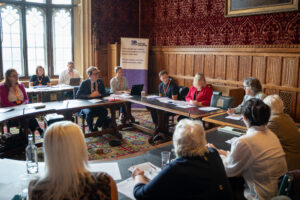
Genetic Alliance CEO Nick Meade at the All-Party Parliamentary Groups (APPGs) meeting
What can you do?
Read and share the report
Help us make sure decision-makers hear the rare community’s voice. Share the report with your networks using #FutureForRare.
Write to your parliamentarians
Ministers are more likely to act when they hear from their colleagues. We are asking you to write to your elected representatives and ask them to write to the Health Minister in your nation, urging them to commit to a renewed UK-wide rare conditions policy before the UK Rare Diseases Framework ends in January 2027.
Find your parliamentarians
You can find your representatives by entering your postcode on the TheyWorkForYou website.
If you live in Scotland, Wales or Northern Ireland, you can write to both your MP and your representatives in your devolved parliament or assembly.
Tips for writing to your parliamentarian:
- Show you are a constituent: Include your full name and address, including your postcode. Most parliamentarians will only respond to people who live in the area they represent.
- Use your own words: A personal letter has much more impact than a template. You can use the following as a guide to structure your letter:
- Tell them why it matters to you: A few sentences about your own or your family’s experience of living with a rare condition can make all the difference.
- Make one clear ask: Ask them to write to the health Minister in your nation, urging them to commit to a renewed UK-wide rare conditions policy, and to share the Minister’s response with you.
- Point them to the evidence: Include a link to the Future for Rare report so they can read our recommendations for themselves.
- Keep it short. One page is plenty. Parliamentarians receive a lot of posts and emails, so something that is brief and focused is more likely to be read.
- Offer to meet. Many parliamentarians hold local surgeries. Meeting in person is a powerful way to share your story.
Please let us know if you write to your parliamentarian, and share any replies you receive with us at [email protected]. This helps us track the campaign’s impact and follow up with decision-makers.
Our next steps
This report is just the beginning. We have received a huge amount of important evidence and community views throughout our campaign and we want to make sure it is all available for our community to use for their own advocacy work.
We will be releasing more information and resources in the coming months, including detailed findings from our Future for Rare expert working groups.
The working groups cover the following themes:
- Diagnosis
- Rare care in the NHS
- Care coordination
- Access to medicines
- Research
- Advocacy, rights and representation
- Data, digital and technology
- Collaboration
- Mental health
- Support for living well with a rare condition
- Governance
Each working group brought together people with lived experience, support organisations, clinicians, researchers and other experts. Together, they turned the findings from our survey and call for evidence into principles, actions and measures of success for their theme.
We think the working groups’ findings deserve to be heard in their own right. As well as shaping a future policy for rare conditions in the UK, they have a lot to offer the wider changes happening in health and care policy across the UK.
Sign up below for campaign updates and be the first to hear when each working group report is published.
How did we get here?
The Future for Rare campaign has been delivered in collaboration with a Future for Rare Steering Group. This multi-stakeholder group includes lived-experience representatives, charity leaders, research and industry experts who ensure the process remains inclusive, transparent, and focused on delivering high-quality evidence to the government.
In 2026, we gathered the views of the rare community through our survey, call for evidence and workshop in a box toolkit. Our 11 thematic working groups then turned these findings into principles for future policy. In September 2026, our summit brought together experts in the community to test and refine our recommendations, in collaboration with LifeArc, Rare Disease Research UK and RD-IMAG.
Thank you to our Working Group Co-Chairs and members, our steering group and everyone in the rare community who shared their views and experiences.
The Future for Rare campaign so far
- The UK Rare Diseases Framework was extended
The current UK Rare Diseases Framework’s five-year deadline was extended until January 2027. The Minister with responsibility for rare conditions at Westminster asked the four nations to submit their proposals for the future of rare conditions policy by autumn 2026.
- Future for Rare survey – closed
The Future for Rare survey closed on Monday 4 May 2026. The survey was designed to capture a comprehensive picture of the experiences and unmet needs of people affected by rare conditions across the UK. Over 700 people from across the UK responded.
- Call for evidence – closed
The Future for Rare call for evidence closed on Monday 4 May 2026. We asked you to share existing reports, papers and publications which could further inform our understanding of the community’s priorities, along with existing rare condition policy recommendations. These were analysed alongside the survey responses.
- Workshop in a box – closed
The Future for Rare workshop-in-a-box toolkit submission closed on Monday 22 June 2026. We produced the Future for Rare: workshop in a box toolkit to help organisations gather and share their communities’ views. Workshop feedback was fed directly into the working groups.
- Thematic working groups
Our Research Team analysed the survey and call for evidence and identified key themes. Eleven thematic working groups then brought together people with lived experience, support organisations, clinicians, researchers and other experts to turn these themes into principles, actions and measurables for future rare conditions policy.
- Future for Rare summit and online webinar – September 2026
In September 2026, our online webinar delivered the working group outputs to the community and received feedback ahead of our summit, held in collaboration with LifeArc, Rare Disease Research UK and RD-IMAG, which brought experts in the community together to test and refine our recommendations.
- Report for Ministers – October 2026
On 21 October 2026, we published Future for Rare: A new vision for rare conditions policy in the UK and wrote to the health Ministers in all four nations.
Before Future for Rare
Genetic Alliance UK has been relentlessly campaigning for the renewal of the UK Rare Diseases Framework. We launched a ‘Manifesto for rare diseases’ with the Specialised Healthcare Alliance ahead of the 2024 General Election and released the impactful report ‘More than you can imagine: opportunities for improving the lives of people with rare conditions’, launched on Rare Disease Day 2025. We have consistently called on the UK governments to commit to a successor framework, capitalising on every opportunity to make this case. We’ve written to the Secretary of State for Health and Social Care, met with the Minister at Labour Party Conference 2025, and advocated during the crucial period of NHS reform to ensure that the unique needs of the rare disease community are central to future policy.
We also actively encouraged Ministers in the devolved nations to agree to the Framework’s extension. Read our letter to Jenni Minto, Minister for Public Health and Women’s Health in Scotland, our letter to Jeremy Miles, Cabinet Secretary for Health and Social Care in Wales and the response we received.
The campaign for renewal of the UK Rare Diseases Framework
The UK Rare Diseases Framework has laid strong foundations and since its publication, new opportunities have emerged. Scientific developments have deepened our understanding of rare conditions, and innovations such as Artificial Intelligence (AI)-driven diagnostics, genomic testing, cell and gene therapies, and digital care support have progressed, presenting opportunities to improve health outcomes and reduce inequalities.
We cannot afford to lose momentum at this critical point. As the current Framework comes to an end, we are calling on the governments of the UK to commit to renewing a UK-wide rare conditions policy.
A manifesto for rare diseases
In March 2024, Genetic Alliance UK published a ‘Manifesto for rare diseases’ in partnership with the Specialised Healthcare Alliance (SHCA), a coalition of patient groups and corporate supporters who campaign on behalf of people with rare and complex conditions.
The manifesto, which formed the cornerstone of Genetic Alliance UK’s General Election 2024 pledge campaign, called on the next government to commit to building on the current UK Rare Diseases Framework by setting new ambitions for improving the lives of people with rare diseases over the next five years. The manifesto set out our calls to action in more detail, including policy changes that could:
- Help patients get a timely diagnosis
- Increase awareness among healthcare professionals
- Improve the coordination of care
- Increase access to specialised care, treatment and drugs
Following the General Election, we wrote to the newly appointed Secretary of State for Health and Social Care, Wes Streeting, to emphasise the value of the UK Rare Diseases Framework. Read our open letter to Wes Streeting.
More than you can imagine: opportunities for improving the lives of people with rare conditions
To mark Rare Disease Day 2025, we launched the ‘More than you can imagine’ campaign. This included the publication of an anthology of creative works that brought to life the experiences of individuals within the genetic, rare and undiagnosed communities through poetry, personal stories, photography and artwork. Alongside ‘More than you can imagine: an anthology of rare experiences’, we published a comprehensive report reflecting on the impact of the UK Rare Diseases Framework and setting the scene for what a renewed Framework could look like.
The report, ‘More than you can imagine: opportunities for improving the lives of people with rare conditions’, recognises that the existing Framework has laid strong foundations and that, since its publication, new opportunities for improving the lives of people with rare conditions have emerged.
The report includes a clear call to the governments of the UK to renew their commitment to rare conditions and ensure that the successor to the existing UK Framework is supported by:
- Ring-fenced funding for each nation
- Well-resourced delivery teams for effective implementation
- Ongoing involvement of the rare conditions community
- Enhanced collaboration across the four nations, including joint initiatives
- Development of clear metrics to monitor progress and evaluate outcomes
- Regular reporting of progress to facilitate comparison and collaboration
We launched our report at Rare Disease Day receptions across the UK, and the report was welcomed by the health ministers of the UK and each nation’s Rare Disease Delivery Groups.
Media coverage of the campaign
Our report was also covered in national media, including a Rare Disease Day article from Metro featuring two families from our community, a story in the i Paper outlining the importance of the UK Rare Diseases Framework and the Telegraph Media Planet Rare Disease Supplement.
Making the case for a renewed UK Rare Diseases Framework in the context of NHS reform
In July 2025, the government launched a new NHS 10 Year Health Plan for England, which could reshape healthcare delivery across England. This came alongside proposals to merge NHS England into the Department of Health and Social Care.
We have strongly urged the government to ensure these reforms do not negatively impact services for rare conditions, and seized this opportunity to advocate for a renewed UK Rare Diseases Framework to safeguard and advance care for this community.
We have also worked with parliamentarians to convey this message to the Minister. The All Party Parliamentary Group on Genetic, Rare and Undiagnosed Conditions wrote to the Minister in July 2025 to advocate for a dedicated rare conditions policy.
Find out more about our work on the NHS 10 Year Health Plan.
Find out more about our work on NHS England reform.